ANZAC DAY 2026. ‘Our ancestors proved that a small nation can wield influence far beyond its size in war – but also can be a powerful moral voice speaking out in the cause for peace and international law’
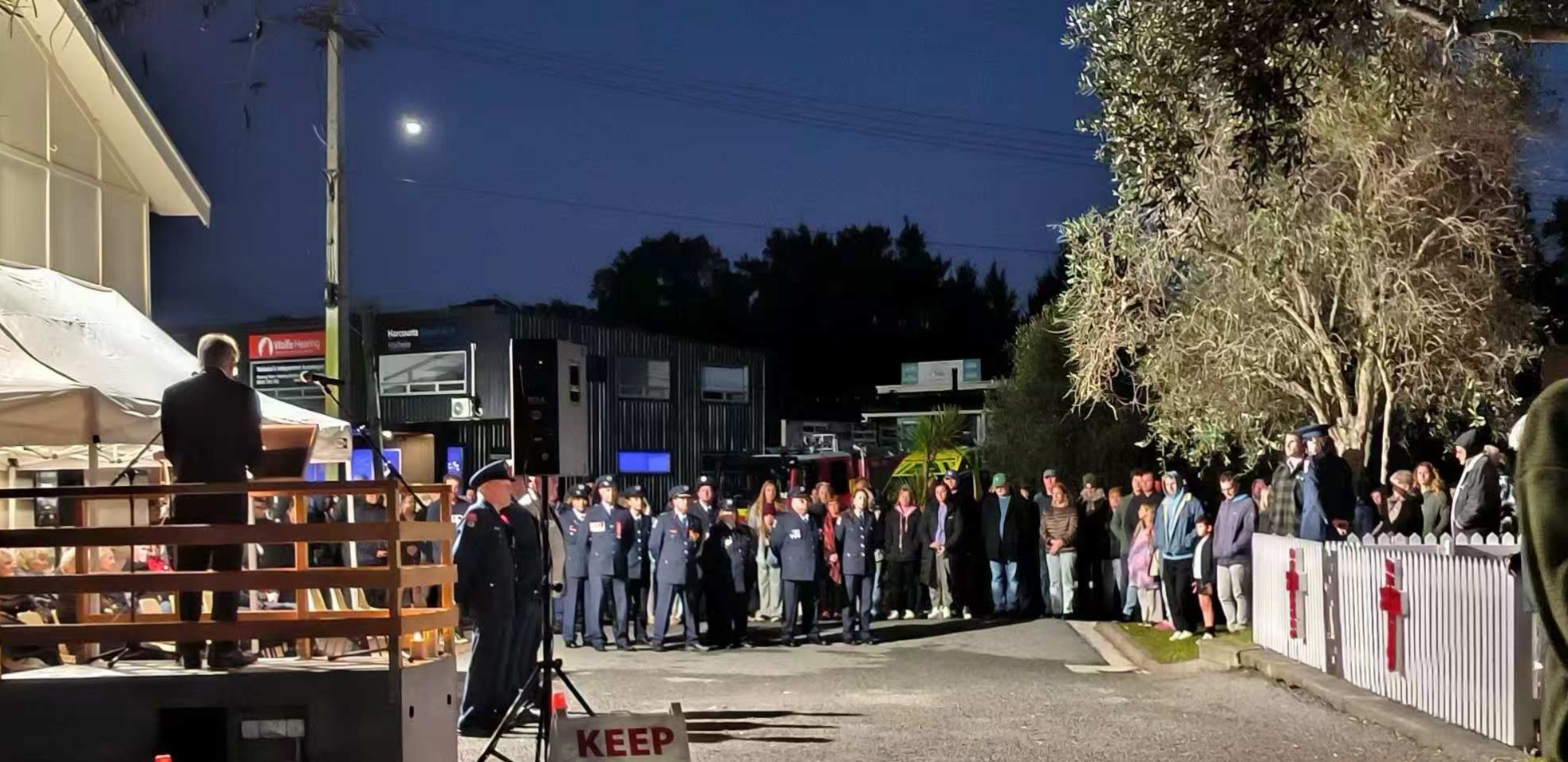
We gather here this morning, at this time and place as is our custom, in the spirit of peace and freedom, but in a world under the shadow of cruel and violent war.
ANZAC Day is the day we pay tribute to those New Zealanders and men and women, who served their country on land, at sea and in the air. We pay special tribute to the fallen – those who made the ultimate sacrifice – ‘who did not grow old as we grow old.’
This is the 110th ANZAC Day which was first established in 1916 during the first World War, one year after the landings of the Australian and New Zealand Army Corps at Gallipoli on 20 April 1915.
The First World War, the soldiers and civilians were told – was ‘a war to end all wars’ – the soldiers and civilians believed it.
Over 102,000 New Zealanders served in the First World War, some 10% of the population. A greater proportion than any other nation.
More than 18,500 lost their lives. Many more were wounded and disabled, many permanently. Heartbreak and sorrow was visited upon thousands of New Zealand homes and families. The hopes for marriage, family life and children for thousands of young women were ruined because so many young men never came back. The social fabric of the country itself must have been weakened by the loss of some of our best, brightest and most courageous young people out of such a small population.
The nation has never really got over it. But it has taken some comfort in recalling not only the selfless devotion to duty, the courage of those young New Zealanders and those that followed them, but has also taken pride in their success on the battlefield. About this the British war historian John Keegan in his book The First World War published in 1998, wrote ‘…The New Zealanders whose settler independence with rifle and spade would win them a reputation as the best soldiers of the twentieth century’.
We recall this not to glorify war, nor from any sense of national chauvinism. We do so to remind ourselves that our ancestors were special people and we their descendants are entitled to take pride in the honour they bestowed on our country.
So in remembering the great sacrifices New Zealanders made in two world wars; we also recall the battle honours for which New Zealand infantry divisions in particular won recognition from friends and foes alike, as elite formations in both the world wars. We also recall our ancestors remarkable war effort on the homefront. The World War II effort in particular, with the thousands of women joining the workforce to take the place of the men fighting on the other side of the world. By the end of the Second World War despite its enormous cost, NZ national debt in 1945 was lower than when the country entered the war in 1939. So successful was this effort that this tiny nation was not only a net donor of war aid to the United Kingdom – but also to the United States of America.
The immense sacrifices of war fostered in New Zealanders not only a deeper sense of their national identity but also an enduring appreciation of the preciousness of peace.
In the year’s leading up to the Second World War as a member of the League of Nations New Zealand often adopted positions independent of the Great powers. Its diplomats openly challenged Great Britain and France especially, for their reluctance to strengthen the League, and for failing to stand up to the Fascist powers in Europe and Japan. This policy enjoyed the support of ordinary New Zealanders. As an example in the late 1930s the NZ Waterside Workers Union refused to work ships loading scrap iron for Japan, arguing it would be used to make war materiel for Japan’s war of aggression against China – and eventually against us.
In the aftermath of World War II from which New Zealand again emerged with enhanced respect and prestige, it was invited by the victorious allied powers to play a key role in the creation of the United Nations. The primary purpose of which, as set out in the United Nations Charter is to maintain international peace and security.
New Zealand’s tradition of independence can be recalled in the memories of many here. In 1973 the government sent a navy frigate to underline in the strongest possible manner New Zealand’s opposition to the France’s atmospheric nuclear weapons testing in the Pacific. And again 11 years later New Zealand upholding its nuclear free law resisted considerable pressure from the United States over the question of visits by nuclear armed or powered war ships. And again in 2003 New Zealand refused to join the US-led ‘coalition of the willing’ in the unlawful invasion of Iraq.
Sadly in the current era, where international law seems to have been cast aide, and where might is treated as right, we see little evidence of moral leadership and independence coming from our government.
Especially so in regard to the abuse of the rules governing wars, as set out in the Geneva Convention, the Haque Convention and the Rome Statute of the International Criminal Court.
The key principle of that body of law is the distinction between combatants and civilians. This is supported by the principle of proportionality of force. Of military necessity. Of avoidance of unnecessary suffering which underpins the bans on chemical weapons. The obligation to protect prisoners and the wounded. The avoidance of destruction of civilian infrastructure, And finally the protection of medical personnel and hospital facilities, ambulances, first responders, humanitarian workers, journalists, and cultural and religious sites.
Today these rules are routinely flouted. Especially so in Gaza. Over the last two and a half years, some 65,000 civilians have been killed in Gaza, including 21,289 children and 44,500 children injured. This according to various authorities including UNICEF. And the violations go on with cruel and reckless abandon – in Lebanon and in Iran including the 168 mainly little schoolgirls killed in the city of Minab, in the surprise attack on that country by the US and Israel of February 28th this year.
And it seems even the dead are given no peace – we recently learned of the desecration of two Commonwealth war cemeteries in Gaza, containing the graves of 38 New Zealand First World War soldiers.
In the Middle East right now there is a cease fire of sorts but which is likely to soon explode into a war even, more violent and destructive than the previous episode which will mean even more civilians and children are likely to be killed or maimed. A war if not a world war – one which will have global scale economic consequences.
Our ancestors proved that a small nation can wield influence far beyond its size in war – but also can be a powerful moral voice speaking out in the cause for peace and international law.
Previous generations of New Zealanders showed us that courage is not counted in numbers, but measured in conviction, not in strength alone but in the values we choose to uphold.
Their legacy is not only one of service and sacrifice but of responsibility -the responsibility we now carry to honour their memory by striving for a more just, lawful and peaceful world.